 English
-
In dredging and slurry transport projects, both dredging rubber hoses and HDPE pipes are commonly used to move sand, mud, silt, and other dredged materials. For many contractors and procurement teams, the question is simple:
Should we choose rubber dredging hoses or HDPE pipes?
The answer is not always one or the other. In real dredging projects, the best solution often depends on the working environment, pipeline layout, material type, pressure requirements, and movement conditions.
This article explains the key differences between rubber dredging hoses and HDPE pipes, and helps you decide which option is more suitable for your project.
1. What Is a Rubber Dredging Hose?
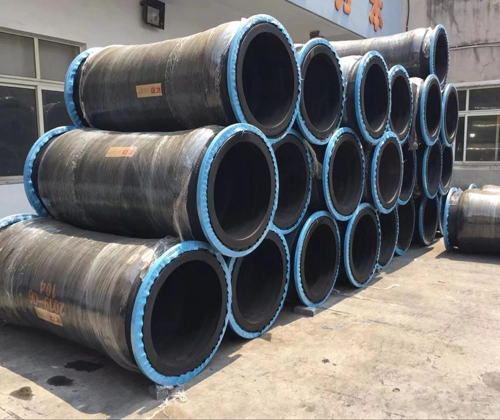
A rubber dredging hose is a flexible hose designed for slurry transport in dredging operations. It is commonly used in suction, discharge, floating, and flexible connection sections.
A typical rubber dredging hose includes:
Wear-resistant inner rubber lining
Reinforcement layers for pressure resistance
Outer rubber cover for weather and abrasion protection
Steel flanges or customized end fittings
Rubber dredging hoses are widely used with cutter suction dredgers, amphibious dredgers, pump-off systems, floating pipelines, and nearshore discharge systems.
Their biggest advantage is flexibility.
2. What Is an HDPE Pipe?
HDPE pipe is a rigid or semi-rigid plastic pipe made from high-density polyethylene. It is commonly used for water transport, slurry pipelines, drainage systems, and dredging pipeline sections.
HDPE pipes are often used in:
Long-distance slurry transport
Floating pipeline systems with external floats
Onshore discharge lines
Stable straight pipeline sections
Their biggest advantage is cost efficiency over long, stable pipeline distances.
3. Key Difference: Flexibility vs Stability
The most important difference between rubber dredging hoses and HDPE pipes is how they respond to movement.
Rubber Dredging Hose
Rubber hoses can bend, move, and absorb vibration. This makes them suitable for sections where the pipeline is affected by dredger movement, waves, tides, pump vibration, or installation misalignment.
HDPE Pipe
HDPE pipes are more rigid and stable. They work well in long, relatively fixed pipeline sections where movement is limited and the layout is simple.
In short:
Rubber hose is better where movement exists.
HDPE pipe is better where the pipeline stays stable.
4. Comparison Table
Factor | Rubber Dredging Hose | HDPE Pipe |
Flexibility | Excellent | Limited |
Movement absorption | Strong | Weak |
Abrasion resistance | High with proper lining | Moderate to high depending on grade |
Pressure resistance | Customizable | Depends on pipe rating |
Installation | Easy in dynamic sections | Efficient in long straight sections |
Maintenance | Easy section replacement | Requires pipe section repair or welding |
Floating use | Self-floating hose available | Requires floats |
Cost per meter | Usually higher | Usually lower |
Best use | Dynamic, high-wear, connection areas | Long, stable transport lines |
5. When Should You Choose Rubber Dredging Hoses?
Rubber dredging hoses are the better choice when the pipeline must handle movement, bending, vibration, or high abrasion.
Typical applications include:
Near the dredger
Pump discharge connections
Suction sections
Floating hose sections
Transition points between steel pipes or HDPE pipes
Areas with waves, tides, or vessel movement
Seabed contact or shallow-water zones when armored hoses are used
In these areas, rigidity can become a problem. If the pipeline cannot absorb movement, stress may concentrate at joints, flanges, or bends. Rubber hoses help reduce this stress and protect the overall system.
6. When Should You Choose HDPE Pipes?
HDPE pipes are suitable for long-distance, stable, and relatively simple pipeline layouts.
Typical applications include:
Long straight discharge pipelines
Onshore slurry transport
Floating pipeline sections with external floats
Low to medium movement areas
Budget-sensitive projects with large pipeline quantities
HDPE pipes are often selected because they are lighter than steel pipes, corrosion-resistant, and more economical for long-distance transport.
However, HDPE pipes are not ideal for areas with strong movement, frequent bending, or high mechanical impact.
7. Maintenance and Replacement
Rubber dredging hoses are easier to replace section by section. If one hose section wears out, it can usually be removed and replaced without affecting the entire pipeline.
HDPE pipes may require cutting, welding, or replacing longer pipe sections depending on the failure location.
In projects where downtime is expensive, rubber hoses are often preferred in high-risk areas because they allow faster maintenance.
8. Cost: Which One Is More Economical?
HDPE pipes usually have a lower cost per meter than rubber dredging hoses. For long, stable pipelines, HDPE can be a cost-effective choice.
However, cost should not be evaluated only by purchase price.
You also need to consider:
Installation cost
Maintenance cost
Downtime risk
Replacement frequency
Slurry abrasiveness
Movement and vibration
Project duration
In many dredging systems, the most cost-effective design is not “all rubber hose” or “all HDPE pipe.” It is a combination of both.
9. The Best Solution: Use Each Where It Performs Best
In real dredging projects, rubber hoses and HDPE pipes are not competitors. They are complementary components.
A practical layout may include:
Rubber suction hose near the dredging head
Rubber discharge hose at pump outlet
Self-floating hose near the dredger
HDPE pipe for long floating or onshore transport sections
Armored rubber hose in seabed contact zones
Rubber connector hoses at transition points
This system-based approach improves reliability while controlling cost.
10. Practical Selection Guide
Project Condition | Recommended Option |
Near dredger or pump outlet | Rubber dredging hose |
Strong waves or vessel movement | Rubber dredging hose |
Long straight onshore line | HDPE pipe |
Long stable floating line | HDPE pipe with floats |
High abrasion transition area | Rubber dredging hose |
Seabed contact area | Armored rubber hose |
Budget-sensitive long pipeline | HDPE pipe |
Frequent repositioning | Self-floating rubber hose |
11. Common Mistakes to Avoid
Mistake 1: Choosing Only by Price
HDPE may be cheaper per meter, but it may not perform well in dynamic or high-impact sections.
Mistake 2: Using Rubber Hoses Everywhere
Rubber hoses are flexible and durable, but using them for long stable pipeline sections may increase unnecessary cost.
Mistake 3: Ignoring Transition Points
Many failures happen where rigid pipes meet flexible hoses. These areas need proper connector design.
Mistake 4: Underestimating Movement
Pipelines near dredgers are constantly moving. Rigid pipes may create stress and lead to joint failure.
Mistake 5: Ignoring Slurry Abrasion
For sand-heavy or gravel-heavy slurry, wear-resistant lining must be considered carefully.
Conclusion: Choose Based on Function, Not Product Name
Rubber dredging hoses and HDPE pipes both play important roles in dredging pipeline systems.
Rubber dredging hoses are best for:
Movement
Flexibility
Pump connections
High-wear sections
Floating and transition areas
HDPE pipes are best for:
Long-distance transport
Stable pipeline layouts
Cost-effective straight sections
Low-movement areas
The smartest choice is usually a combined system that uses each product where it performs best.
For dredging contractors and engineering teams, the goal is not to choose rubber hose or HDPE pipe blindly. The goal is to build a safe, efficient, and cost-effective slurry transport system.
Need Help Choosing Between Rubber Dredging Hose and HDPE Pipe?
At YH Rubber Hose, we support dredging contractors, equipment suppliers, and engineering teams with project-based hose selection.
We provide:
Armored hoses for high-risk sections
Customized hose assemblies for floating, submerged, and onshore pipeline systems
Technical drawings and export-ready documentation
If you are unsure whether your project should use rubber dredging hoses, HDPE pipes, or a combined pipeline solution, contact our team with your dredger type, pump data, slurry material, and pipeline route. We can help you evaluate the right configuration before production.
- Dredging Rubber Hose: Rubber Band in Dredging Projects
- Introduction of Floating Rubber Hose
- Situation and Development of the Dredge Rubber Hose
- Dredging Hose Standards and Testing Explained: What Buyers Really Need to Know
- Armored Self-Floating Rubber Pipe: A Comprehensive Overview
- Rubber Fender For Ship: A New Type of Fender Equipment