 English
-
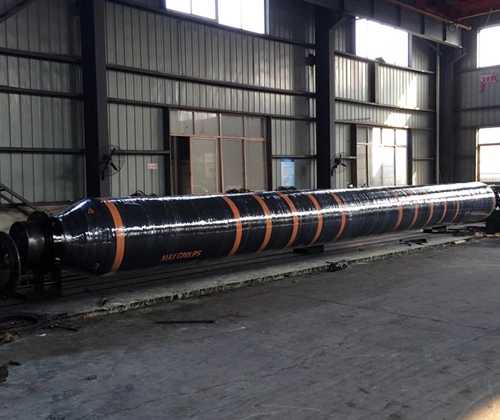
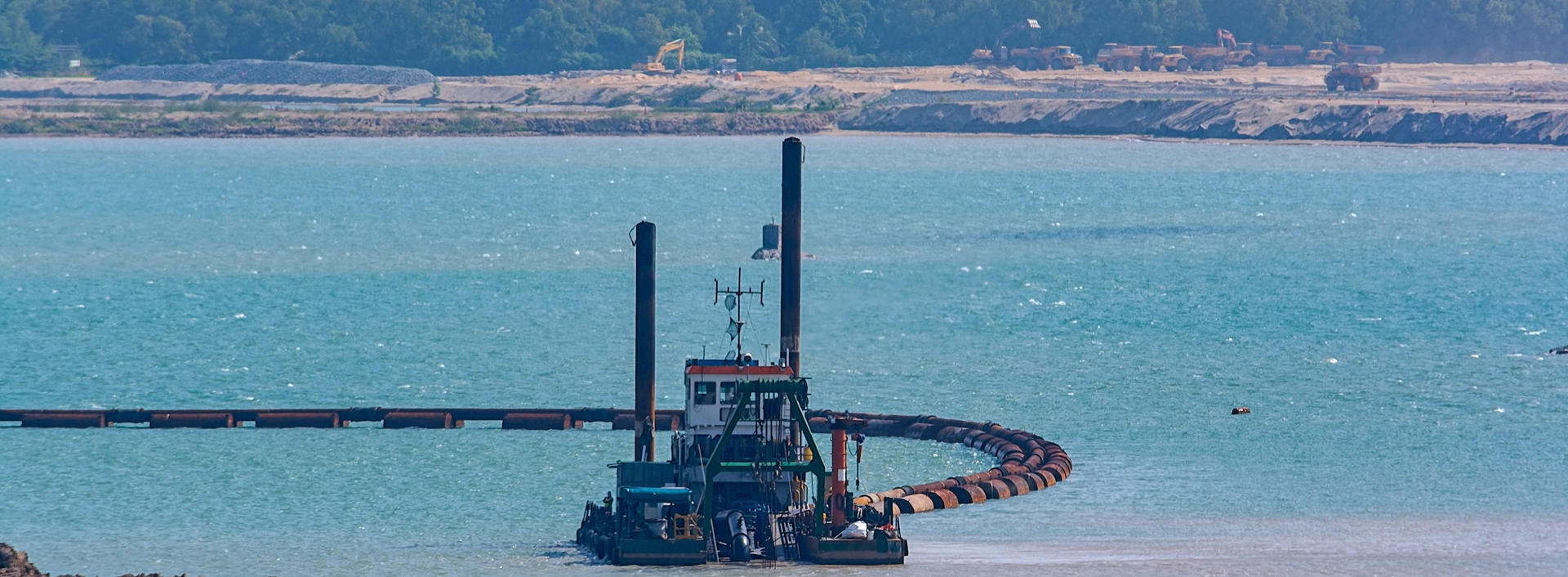
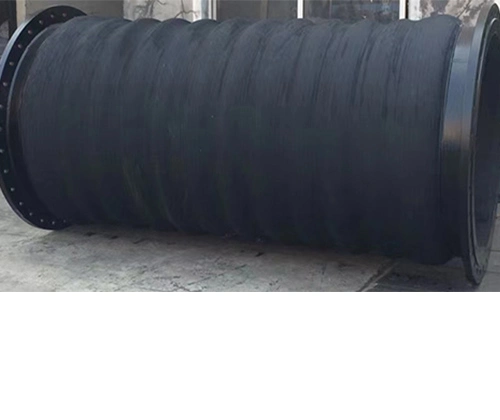
A self-floating dredge hose is a flexible slurry transport hose with an integrated buoyancy layer that allows the complete hose assembly to remain afloat without separate pontoons or external floats. YongHong manufactures self-floating hoses for transporting sand, mud, sediment and dredged slurry in offshore dredging, port maintenance, land reclamation, beach nourishment and marine construction projects. Hose diameter, length, working pressure, reinforcement structure, buoyancy configuration and flange connection can be customized according to the pipeline layout and operating conditions.
Compared with a conventional discharge hose supported by separate floats, an integrated self-floating rubber hose reduces the number of independent pipeline components and allows the floating section to move more flexibly with waves, currents and dredger position changes.
For complete suction, discharge, floating and armored hose options, review our dredge rubber hose.
Outstanding Features of Self-floating Rubber Hose
Low Center of Gravity
The built-in buoyancy layer is positioned to give the hose a low center of gravity, ensuring superior stability on the water’s surface. This minimizes rolling and movement during operation, even under rough sea conditions.
Wear Resistance
The inner lining is made from high-quality, wear-resistant rubber or polymer compounds, significantly extending service life when handling abrasive materials such as sand, gravel, and slurry.
Good Flexibility
Designed for excellent bending performance, the hose adapts easily to waves, tides, and vessel movements without kinking or collapsing. This flexibility ensures smooth material flow and easier alignment with dredging equipment.
Easy Maintenance Advantages
Compared to steel pipelines and traditional float assemblies, self floating rubber hoses are lighter, easier to install, and require less frequent maintenance. This reduces downtime, lowers labor costs, and improves overall project efficiency.
How Self-floating Rubber Hose Works
The self floating rubber hose combines buoyant outer layers with a strong inner structure to maintain flotation during operation. As slurry, sand, or mud is pumped through the hose, the buoyant layer offsets the weight of the material and the hose itself, allowing it to float continuously.
In many dredging systems, the self floating rubber hose works in tandem with mud suction hose assemblies to create a complete material transport line. While the mud suction hose handles intake from the seabed or riverbed, the floating hose efficiently discharges the material over water, ensuring smooth and coordinated operation.
This floating capability eliminates the need for additional flotation devices, streamlining the setup process and reducing downtime. The hose’s flexibility helps it adapt to tides, waves, and vessel movements, preventing kinks or collapses. This ensures smooth and uninterrupted material flow, making it ideal for offshore dredging and land reclamation projects.
Self-Floating Dredge Hose Construction
A self-floating dredge hose normally contains several functional layers. Each layer contributes to abrasion resistance, pressure capacity, flexibility, buoyancy and protection from the marine environment.
Wear-Resistant Inner Lining
The inner lining is in direct contact with sand, mud, slurry and abrasive particles.
Its material and thickness should be selected according to:
Particle size
Particle hardness
Slurry concentration
Flow velocity
Operating pressure
Expected service life
A hose carrying fine mud may require a different inner lining from a hose used for coarse sand or mineral slurry.
Reinforcement Layers
The reinforcement structure helps the hose resist internal pressure while maintaining dimensional stability during bending and movement.
Depending on the hose size and pressure rating, the reinforcement may include:
Textile cord layers
Steel wire reinforcement
Helical support structures
Project-specific reinforcement combinations
The final structure must match the required working pressure, burst pressure and bending performance.
Integrated Buoyancy Layer
The buoyancy layer supports the combined weight of the hose, flanges and transported slurry.
Its design should consider the complete hose assembly rather than the rubber body alone. Buoyancy that is adequate for an empty hose may not be sufficient when dense slurry fills the pipeline.
The required buoyancy depends on:
Hose dimensions
Hose length
Slurry density
Flange weight
Connection components
Desired freeboard
Wave movement
Safety allowance
Outer Protective Cover
The outer rubber cover protects the hose from:
Seawater
UV exposure
Ozone
Weather
External abrasion
Handling damage
Contact with nearby pipeline sections
The surface can also use visible markings to identify the product model, diameter, pressure rating and production information.
Flange Connection
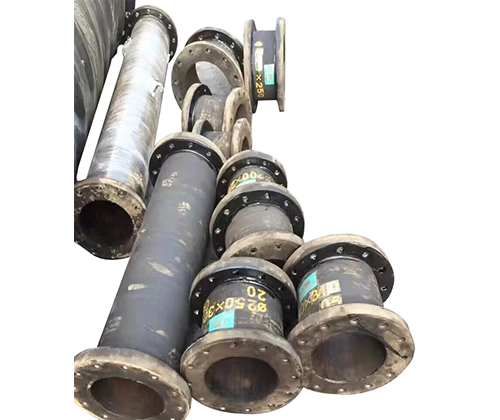
The flange connects the self-floating hose to pumps, other rubber hoses, steel pipes or HDPE pipeline sections.
The following details should be confirmed before production:
Flange diameter
Bolt pattern
Pressure rating
Sealing surface
Material
Connection standard
Corrosion protection
DIN, ANSI, JIS or customized connections may be available, subject to manufacturing confirmation.
Self-Floating Hose vs Other Floating Pipeline Options
Self-floating hoses, externally supported rubber hoses and steel pipes each serve different roles in a dredging pipeline.
| Comparison | Self-Floating Hose | Rubber Hose with External Floats | Steel Pipe with Pontoons |
| Buoyancy | Integrated into hose | Separate floats required | Separate pontoons required |
| Flexibility | High | Medium to high | Low |
| Wave Adaptability | High | Depends on float arrangement | Limited |
| Number of Components | Fewer separate parts | More assembly components | Heavy pipe and support components |
| Installation | Relatively simple | Requires float positioning | Requires lifting and support equipment |
| Repositioning | Easier | Moderate | More difficult |
| External Impact Resistance | Moderate | Moderate | High |
| Typical Use | Dynamic floating sections | Configurable floating sections | Stable or long pipeline sections |
A self-floating hose is not automatically the best option for every part of a dredging pipeline.
Steel pipe may be more suitable for:
Long stable pipeline sections
Higher external impact exposure
Fixed onshore routes
Applications requiring rigid alignment
Self-floating rubber hoses are generally more suitable for:
Water-surface pipeline sections
Dredger connections
Sections requiring regular repositioning
Areas exposed to waves and movement
Flexible transitions between pipeline components
Many projects use a combination of rubber hoses, HDPE or steel pipes. Our detailed floating hose vs steel pipe comparison explains how the two options can be used within the same system.
Self-Floating Dredge Hose Project Configuration
The correct hose configuration depends on actual project conditions. A technical review should be completed before confirming production.
A typical project specification includes:
| Project Parameter | Required Information |
| Project Location | Country, port, river or offshore area |
| Application | Dredging, reclamation, sand mining or slurry transport |
| Transported Material | Mud, sand, sediment, gravel or tailings |
| Slurry Density | Required for buoyancy evaluation |
| Maximum Particle Size | Used for inner lining and armored structure selection |
| Hose Inside Diameter | Matched to pump and pipeline |
| Hose Length | Based on layout and connection spacing |
| Working Pressure | Normal operating pressure |
| Maximum Pressure | Surge or temporary pressure |
| Flange Standard | DIN, ANSI, JIS or custom |
| Required Quantity | Number of hose sections |
| Pipeline Position | Floating discharge section |
| Marine Conditions | Waves, current and water depth |
| Delivery Requirement | Destination and required date |
Why Choose YongHong Self-Floating Dredge Hoses?
Project-Based Buoyancy Configuration
The buoyancy structure is reviewed according to hose size, slurry density, flange weight, pipeline position and required freeboard.
Custom Hose Dimensions
Hose diameter, length, pressure rating, reinforcement, buoyancy layer, flange connection and product marking can be configured according to the confirmed order specification.
Inspection Before Shipment
Applicable dimensional, pressure, buoyancy, flange and visual inspections can be completed according to the agreed quality plan.
Technical Drawing Confirmation
Product drawings and major specifications are confirmed before production to reduce connection errors and specification mismatches.
Export and Documentation Support
YongHong can support product marking, export packaging, packing documents and inspection records according to project requirements.
More information about YongHong manufacturing capabilities and company qualifications is available on our company page.
Applications of Self-floating Rubber Hose
Self floating rubber hoses are widely used in:
Port and waterway dredging — Efficient discharge of sand, gravel, and slurry over long distances.
Land reclamation projects — Transporting materials for coastline expansion and infrastructure development.
Offshore sand mining & beach nourishment — Reliable operation in harsh marine conditions.
Environmental dredging — Precision applications that require minimal ecological disturbance.
Their buoyant design enhances operational safety, reduces the need for heavy lifting equipment, and ensures excellent adaptability in various marine engineering scenarios.
FAQ
What is a self-floating dredge hose?
A self-floating dredge hose is a flexible slurry transport hose with an integrated buoyancy layer. It is used in floating pipeline sections to transport sand, mud, sediment and other dredged materials without separate external floats.
How does a self-floating hose remain afloat?
The hose contains a buoyancy layer designed to offset the weight of the hose, flanges, connection components and transported slurry. The required buoyancy depends on hose size, slurry density, flange weight and desired freeboard.
Does a self-floating hose need external floats?
A correctly designed self-floating hose is intended to remain afloat without separate external floats. However, the final hose assembly and project conditions should be reviewed to confirm sufficient buoyancy under loaded operating conditions.
What is the difference between a self-floating hose and an armored self-floating hose?
A standard self-floating hose is generally used for mud, silt, sand and normal slurry transport. An armored hose includes additional protection for coarse, sharp or highly abrasive materials such as gravel and coral fragments.
What information is required to calculate hose buoyancy?
The required information normally includes hose diameter, hose length, hose body weight, slurry density, flange weight, connection components, required freeboard and marine operating conditions.
Can the hose diameter, length and flange be customized?
Yes. Hose diameter, length, pressure rating, reinforcement structure and flange connection can be customized according to the existing pipeline and project requirements, subject to technical confirmation.
How is a self-floating dredge hose tested?
Depending on the agreed specification, testing may include dimensional inspection, hydrostatic pressure testing, buoyancy inspection, bending inspection, flange inspection and rubber material testing.
What information should I provide for a quotation?
Please provide the hose inside diameter, required length, working pressure, transported material, slurry density, maximum particle size, flange standard, quantity, project location and required delivery date.
Dredge Hose
-
 Aug 31 , 2026Types of Marine Fenders: A Practical Guide for Ports, Docks and Marine BerthingMarine fenders are energy-absorbing protection systems installed between vessels and berthing structures to reduce impact force during docking, mooring and ship-to-ship operations. For ports, wharves,...
 -
 Aug 31 , 2026How to Seal a Rubber Hose: Practical Methods for Industrial and Marine ApplicationsSealing a rubber hose means creating a leak-resistant connection at the hose end, joint, flange, coupling or damaged area so fluid, slurry, air or water can move safely under the required working cond...
 -
 May 29 , 2026Top 7 Mistakes When Selecting Dredging Hoses and How to Avoid ThemAnd How to Avoid ThemSelecting dredging hoses may look simple on the surface. Many buyers start with diameter, pressure rating, and price. However, in real dredging projects, hose performance depends ...
- Rubber Dredging Hose vs HDPE Pipe: Which One Should You Choose?
- How to Choose the Right Dredging Hose Diameter for Your Project?
- How Dredging Conditions (Sand, Clay, Gravel) Affect Hose Selection
- Dredging Hose Layout Design: Floating, Submerged, and Onshore Configurations
- How to Match Dredging Pumps and Hoses Correctly
- Why Cheap Dredging Hoses Fail in Real Projects
- Floating Hose vs Steel Pipe: Which Is Better for Your Project?