 English
-
Marine fenders are energy-absorbing protection systems installed between vessels and berthing structures to reduce impact force during docking, mooring and ship-to-ship operations. For ports, wharves, shipyards, tugboats, workboats and offshore facilities, choosing the right fender type is essential for vessel safety, berth protection and long-term maintenance cost.
Yonghong manufactures marine rubber fenders, dredge rubber hoses and industrial rubber hose products for marine, dredging, municipal, docking and industrial applications. Yonghong marine fenders can be customized by dimensions, rubber hardness, mounting holes, connection details and product markings according to project drawings and installation requirements.
What Are Marine Fenders?
Marine fenders are protective rubber, foam or pneumatic systems designed to absorb berthing energy and reduce reaction force between a vessel and a dock, quay, pier or another vessel. Their main purpose is to prevent damage to both the ship hull and the berthing structure.
A fender system should be selected according to vessel size, berthing energy, approach speed, berth structure, tidal range, mooring conditions and maintenance access. The PIANC Fender Guidelines 2024 emphasize that the total marine structure should be designed integrally, not only the fender unit itself. This means the fender, panel, chains, anchors, berth face and operating environment should be considered together.
In practical engineering, fenders are not chosen by shape alone. A small tugboat, a container terminal, a ferry berth and a dredging vessel may all require different fender types because their impact energy, hull contact area and berthing behavior are different.
Common Types of Marine Fenders
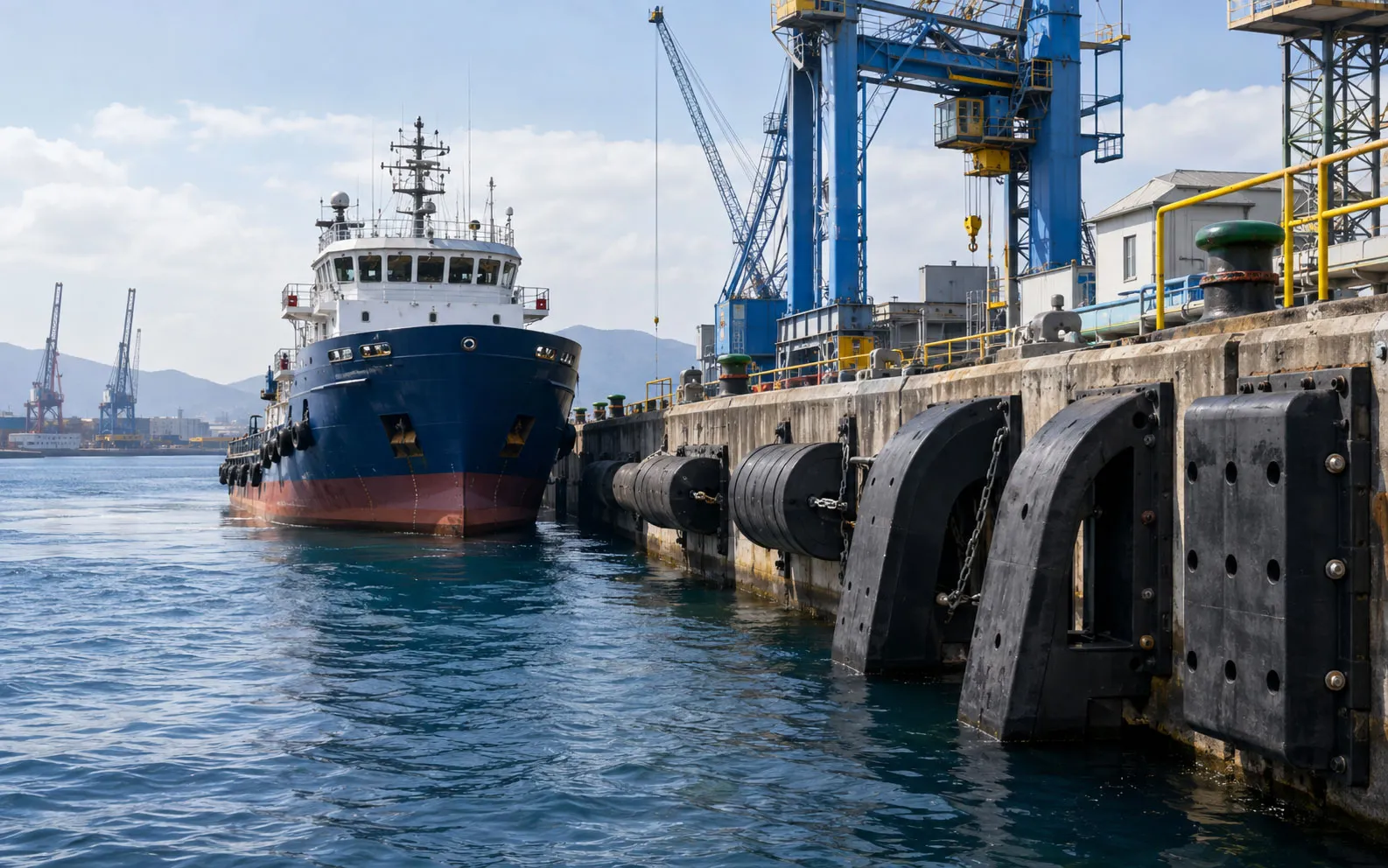
Common types of marine fenders include cone fenders, cell fenders, arch fenders, cylindrical fenders, D-type fenders, pneumatic fenders and foam-filled fenders. Each type has a different energy absorption method, reaction force level, installation style and best-use scenario.
Cone fenders and cell fenders are often used for ports and heavy-duty berths where high energy absorption is required. Arch fenders are simple and durable, making them suitable for smaller terminals, workboat berths and general dock protection. Cylindrical fenders are versatile and can be installed horizontally or vertically. D-type fenders are compact and commonly used on tugboats, small docks, pontoons and quay walls.
Floating pneumatic fenders are widely used for ship-to-ship and ship-to-berth operations. ISO 17357-1 specifies material, performance and dimensional requirements for high-pressure floating pneumatic rubber fenders used for berthing and mooring applications.
Foam-filled fenders are another floating option. They are often selected where unsinkable performance, low maintenance and strong impact resistance are required. A major marine fender guide explains that fender systems may be grouped into buckling fenders, pneumatic fenders and side-loaded systems, showing how different designs absorb energy in different ways.
Marine Fender Type Comparison Table
A marine fender comparison should focus on berthing energy, reaction force, vessel type, installation method and maintenance requirements. The table below gives buyers a practical overview before detailed engineering selection.
| Fender Type | Main Structure | Best Use | Key Advantage | Main Consideration |
| Cone Fender | Rubber cone with front panel | Container terminals, large berths | High energy absorption and stable performance | Needs panel, chain and anchor design |
| Cell Fender | Cylindrical rubber cell with panel | Heavy-duty port berths | Strong energy absorption | Requires enough installation space |
| Arch Fender | Solid rubber arch shape | Small ports, quay walls, workboat berths | Simple, strong and low maintenance | Lower performance than cone/cell systems |
| Cylindrical Fender | Hollow rubber cylinder | General docks, tugboats, pontoons | Easy installation and flexible use | Contact area and mounting must be checked |
| D-Type Fender | D-shaped rubber profile | Small vessels, pontoons, workboats | Compact and economical | Limited energy absorption for large vessels |
| Pneumatic Fender | Air-filled floating rubber body | Ship-to-ship, temporary berthing | Large deformation and floating flexibility | Pressure and chain-net maintenance |
| Foam-Filled Fender | Closed-cell foam core with outer skin | Offshore, ship-to-ship, exposed berths | Unsinkable and durable | Higher initial cost |
For Yonghong projects, dimensions, rubber hardness, fixing holes and connection details can be adapted to installation drawings. This is important because two fenders of the same “type” may perform very differently if size, rubber grade, panel area or mounting structure changes.
How to Choose the Right Marine Fender Type
Choosing the right marine fender type means matching fender performance to vessel size, berth structure, berthing energy, hull pressure limit and operating environment. The best fender is not always the largest one; it is the one that absorbs the required energy while keeping reaction force and hull pressure within safe limits.
For fixed port structures, cone, cell and arch fenders are common choices. Cone and cell fenders are better for higher-energy berthing, while arch fenders can be more economical for smaller vessels and lighter-duty docks. For floating operations, pneumatic and foam-filled fenders are often better because they move with the vessel and water level.
Designers should calculate berthing energy before choosing a fender. PIANC guidance notes that the design process should identify fender types likely to satisfy the project’s primary criteria, then compare published performance data such as energy absorption and reaction force.
Yonghong can support port owners, contractors and distributors with marine fender selection based on berth layout, vessel type, installation space and project drawings. For projects involving dredging vessels or marine slurry transport, Yonghong can also coordinate fender solutions with dredge hose systems and other rubber products.
Installation and Maintenance Considerations for Marine Fenders
Marine fender installation and maintenance involve proper anchoring, spacing, alignment, inspection and replacement planning so the fender system performs safely throughout service life. Even a good fender can fail early if it is poorly installed or not maintained.
Installation checks should include anchor bolt strength, panel alignment, chain length, contact face position, fender spacing, rubber clearance and berth surface condition. For floating fenders, inflation pressure, chain-net condition, tire net condition and surface wear should be inspected regularly.
Maintenance should focus on cracks, permanent deformation, torn rubber, corrosion of chains or bolts, loosened anchors and abnormal hull contact marks. In high-traffic ports, periodic inspection is essential because repeated berthing impacts can gradually reduce system performance.
Yonghong marine rubber fenders are designed for ports, wharves, shipyards, workboats and other berthing applications. Buyers can request customized drawings, markings and connection details to improve fit with the berth structure and reduce installation issues.
Conclusion
Marine fenders come in many types, including cone, cell, arch, cylindrical, D-type, pneumatic and foam-filled fenders. Each type has a different structure, energy absorption behavior and best-fit application. Fixed rubber fenders are commonly used for ports and quay walls, while pneumatic and foam-filled fenders are more suitable for floating, offshore and ship-to-ship operations.
For reliable berth protection, buyers should select fenders based on vessel size, berthing energy, reaction force, hull pressure, water level variation, installation layout and maintenance plan. Yonghong provides marine rubber fenders and customized rubber products for docks, ports, dredging vessels and marine engineering projects.
FAQ
1. What are the main types of marine fenders?
The main types include cone fenders, cell fenders, arch fenders, cylindrical fenders, D-type fenders, pneumatic fenders and foam-filled fenders.
2. Which marine fender is best for large ports?
Cone fenders and cell fenders are often used for large ports because they provide high energy absorption and can work with front panels.
3. What is a pneumatic marine fender used for?
A pneumatic marine fender is commonly used for ship-to-ship transfer, temporary berthing and ship-to-dock protection where floating flexibility is needed.
4. What is the difference between pneumatic and foam-filled fenders?
Pneumatic fenders are air-filled, while foam-filled fenders use a closed-cell foam core. Foam-filled fenders are often selected when unsinkable performance is important.
5. How do I choose the right rubber fender size?
Fender size should be chosen based on berthing energy, vessel size, approach speed, hull pressure, berth structure, tide range and manufacturer performance data.
6. Why choose Yonghong marine fenders?
Yonghong manufactures marine rubber fenders for ports, wharves, shipyards and workboats, with customization available for dimensions, rubber hardness, mounting holes, connection details and markings.

- Custom Engineered Dredge Hose Solutions for Bulk Purchases
- Rubber Fender For Ship: A New Type of Fender Equipment
- What Is the Difference Between Armored Hoses and Common Rubber Hoses?
- Building the Maldives with Reliable Dredging Systems
- Types of Dredging Hoses Suitable for Capital Dredging Works
- A Repo of China Dredging Technology & Equipment Expo 2025